
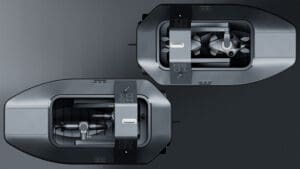
Bubble Robotics, founded in 2025 by former engineers from NASA and ETH Zürich, has secured the round from Episode 1 Ventures, Asterion Ventures and Norrsken Evolve, following its incubation through London-based talent investor Entrepreneur First. The company is already sitting on more than $4m of signed letters of intent across offshore wind, subsea infrastructure and maritime security, suggesting commercial pull is running well ahead of the typical pre-seed playbook.
The pitch is straightforward, if ambitious. Today, inspecting an offshore wind turbine, a buried data cable or a section of seabed pipework typically demands a chartered vessel, a specialist crew and a daily bill that can climb to $100,000. According to Bubble’s founders, between 80 and 90 per cent of those costs are tied up in the boat and the people on it, rather than in the inspection itself.
“By removing that dependency, we unlock a step change in cost, safety and operational frequency,” said Jean Crosetti, chief executive and co-founder. “What used to be episodic becomes continuous.”
The plan is to dispense with vessel-based missions altogether and instead deploy fleets of resident autonomous robots that live at sea for months at a time, continuously inspecting, monitoring and gathering data without human intervention. Crosetti likens the model to the satellite constellations that have transformed earth observation over the past decade, only pointed downward into the water column rather than up at the atmosphere.
The timing reflects a wider inflection point. Cheaper edge computing, more capable on-device AI and the rapid expansion of low-earth-orbit satellite connectivity have, between them, made persistent unmanned operations technically feasible in a way they were not even three years ago. The macro pull is equally significant: the offshore energy sector alone is forecast to need an additional 600,000 workers by 2030, a shortfall that no graduate scheme is going to plug in time.
Bubble is selling its capability on a robotics-as-a-service basis, sparing customers the upfront capital expenditure and offshore mobilisation costs that have traditionally locked smaller operators out of high-frequency inspection regimes. Target use cases span the inspection of wind turbine foundations, cables, pipes and subsea structures; benthic mapping, photogrammetry and biofouling monitoring for climate and biodiversity clients; and mine countermeasures, unexploded ordnance detection and continuous surveillance for defence and maritime security buyers.
That last category is increasingly pertinent. Recent incidents involving subsea data cables in the Baltic and North Sea have pushed the security of underwater infrastructure up the agenda for European governments and Nato, exposing how thinly monitored much of it remains. Persistent autonomous systems offer a way to maintain a continuous presence around sensitive assets without committing scarce naval resources.
Alice Bentinck, co-founder of Entrepreneur First, said the founders had stood out from the moment they met at one of the firm’s kick-off weekends. “Patricia and Jean formed a team around a shared belief and complementary skill-set: Patricia with world-class technical credibility in robotics, Jean with unusual commercial instinct and intensity. Their pace of iteration throughout the programme and strong customer obsession make Bubble Robotics a company to watch closely.”
For the wider SME ecosystem, Bubble’s emergence is a useful data point. It suggests that capital is still flowing into deep-tech start-ups with credible commercial traction, even as more speculative AI plays cool, and that the long-promised convergence of robotics, AI and connectivity is finally producing businesses with revenue lines attached, not just demos.
Read more:
Bubble Robotics surfaces from stealth with $5m to build the ocean’s autonomous workforce